Colostrum Capsules vs. Powder: Convenience, Dose and Cost Compared
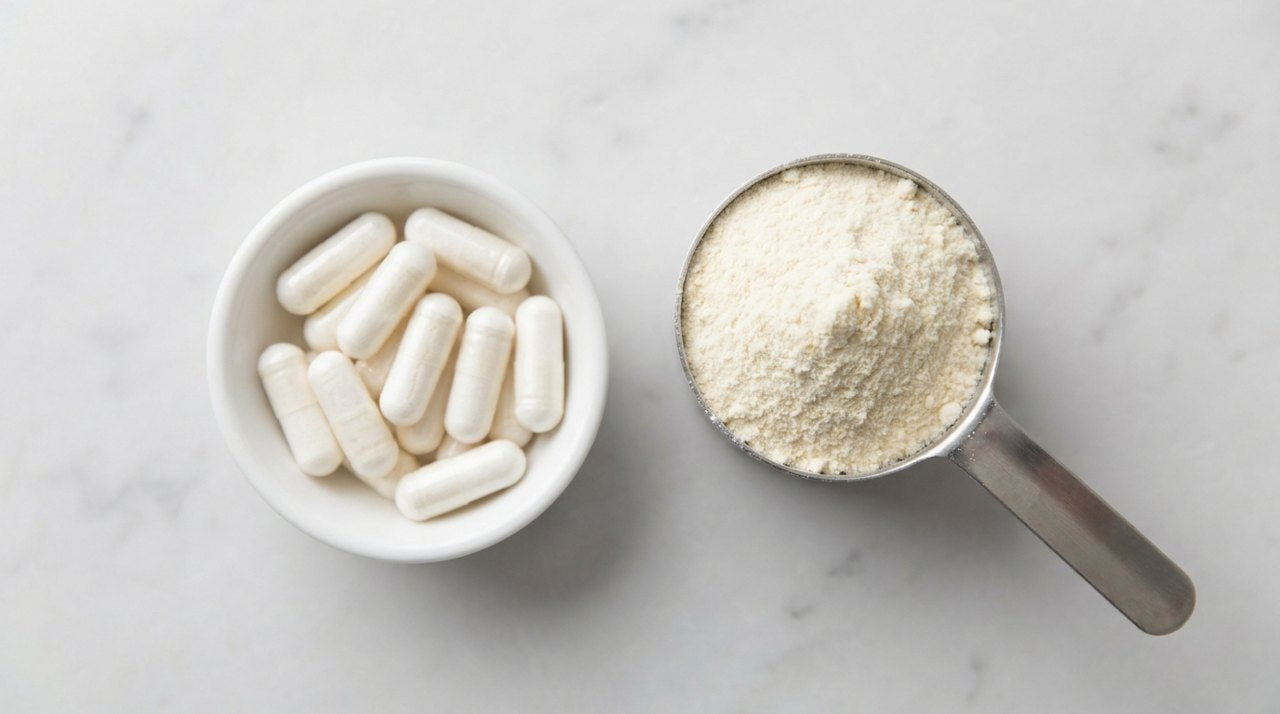
If you have decided to try colostrum, the next fork in the road is a practical one: capsules or powder? Both deliver the same core ingredient, dried bovine colostrum, but they differ in how much you actually get per dose, how convenient they are to take and what each gram ends up costing you. This guide walks through those trade-offs honestly so you can pick the format that fits your routine rather than the one with the nicer packaging.
What is actually inside each format
Start with the reassuring part: a capsule of colostrum and a scoop of colostrum powder are, in principle, the same thing. Manufacturers collect first milking colostrum, gently dry it into a fine powder and then either package that powder loose or press it into gelatin or vegetable capsules. The bioactive components people care about, such as immunoglobulin G (IgG), lactoferrin, oligosaccharides and growth factors, are present in both.
The differences show up in the details. Encapsulation often requires flow agents like magnesium stearate or silicon dioxide so the powder moves cleanly through filling machines. Some capsule products also add rice flour or maltodextrin to reach a consistent fill weight. None of these are harmful at typical amounts, but they do mean the "colostrum" on the label may not be 100% colostrum. A loose powder can be sold with nothing added at all, which is worth checking on any label you are comparing.
Dose: the number most people overlook
This is where the two formats diverge most sharply. A standard capsule holds roughly 400 to 800 mg of powder. Research on bovine colostrum in adults has used a wide range of daily amounts, but many studies fall somewhere between 2 and 20 grams per day, and some sports and gut-focused trials went higher. Even at the low end of that range, reaching 2 grams from 500 mg capsules means swallowing four capsules a day. Reaching 10 grams would mean twenty.
That arithmetic matters for two reasons:
- Adherence. People tend to take one or two capsules because that is what feels normal, which may leave them well below the amounts studied. If a product works at all, it is unlikely to work at a fraction of the dose.
- Flexibility. With powder you can start small, see how your digestion responds, and adjust in half-gram steps. Capsules lock you into fixed increments.
Whichever format you choose, look for two numbers on the label: grams of colostrum per serving and the IgG percentage. A 2 gram serving at 25% IgG delivers roughly 500 mg of IgG. A capsule product may list only "500 mg proprietary blend," which tells you very little. If you are curious what the other bioactive fractions do, our piece on growth factors in colostrum explains what IGF-1 and TGF-β mean for adults.
Convenience: honest pros and cons
Where capsules win
- No mixing, no spoon, no glass to rinse.
- Easy to travel with and discreet to take at work.
- No taste at all, which helps if you dislike dairy flavors.
Where powder wins
- Precise, adjustable dosing without counting pills.
- Mixes into water, milk, yogurt or a smoothie, so it fits into an existing habit rather than adding a new one.
- Usually fewer excipients, since nothing is needed to make it flow through a capsule machine.
The taste objection to powder is smaller than people expect. Pure, unflavored colostrum tastes mildly creamy and slightly sweet, closer to powdered milk than to anything medicinal. It disperses well in cool or room-temperature liquid. One caution: avoid stirring it into very hot drinks, because immunoglobulins are proteins and heat may denature them. We covered the evidence and some better options in Can You Put Colostrum in Coffee?
Cost: compare per gram, not per bottle
Sticker prices are misleading because capsule bottles look cheaper while containing far less product. The only fair comparison is cost per gram of colostrum, and ideally cost per gram of IgG. The table below uses illustrative figures rather than specific brands, but the pattern holds across most of the market.
| Format | Typical container | Colostrum per container | Illustrative price | Approx. cost per gram |
|---|---|---|---|---|
| Capsules (500 mg) | 120 capsules | 60 g | $35 | $0.58 |
| Capsules (800 mg) | 90 capsules | 72 g | $45 | $0.63 |
| Powder | 120 g tub | 120 g | $45–60 | $0.38–0.50 |
Encapsulation adds labor, materials and packaging, so capsules almost always cost more per gram. The gap widens if you take a research-relevant dose. Someone taking 2 grams daily from 500 mg capsules would go through a 120-count bottle in a month; a 120 g powder tub at the same dose lasts two months. For context, Bluegrass Colostrum is packaged as 120 g with a 2 gram scoop, which is where the "60 servings" figure comes from, and it contains no flow agents or fillers, so every gram on the label is colostrum.
Quality variables also affect price and are easy to miss. Colostrum collected within the first hours after calving has substantially higher immunoglobulin content than later milkings. Grass-fed sourcing, low-heat processing and third-party testing all add cost, whether the end product goes into a capsule or a tub. A cheap capsule and a premium powder are not the same ingredient in different clothes.
Does the format change how well it works?
Probably not much. Some capsule brands market enteric coatings, arguing they protect IgG from stomach acid. Research suggests a meaningful fraction of colostrum immunoglobulins survives digestion even without coating, and the local effects in the gut appear to be part of the story anyway. Human trials comparing coated capsules to plain powder head to head are scarce, so treat those claims as plausible marketing rather than established fact.
What seems to matter more is consistency. The studies that report benefits generally involved daily use over weeks, not occasional doses. If you are wondering whether that daily habit is reasonable over the long haul, we looked at the available evidence in Taking Colostrum for Months or Years.
A simple way to decide
- Choose capsules if you travel constantly, genuinely will not mix a powder, and are comfortable taking four or more capsules daily to reach a meaningful amount.
- Choose powder if you want the lowest cost per gram, the fewest additives, and the ability to fine-tune your dose. Most people who already make a morning smoothie, yogurt bowl or glass of milk find that powder disappears into that routine within a few days.
- Either way, read the label for grams per serving, IgG percentage, collection window and third-party testing. Those four details tell you more about value than the format ever will.
Colostrum is a dietary supplement, not a medicine, and the evidence for many of its proposed uses is still developing. Whatever format you land on, the most useful thing you can do is take a consistent, label-honest dose and pay attention to how you feel over a few weeks rather than a few days.
These statements have not been evaluated by the Food and Drug Administration. This product is not intended to diagnose, treat, cure, or prevent any disease.