Colostrum vs. a Multivitamin: Which Daily Habit Earns Its Shelf Space?
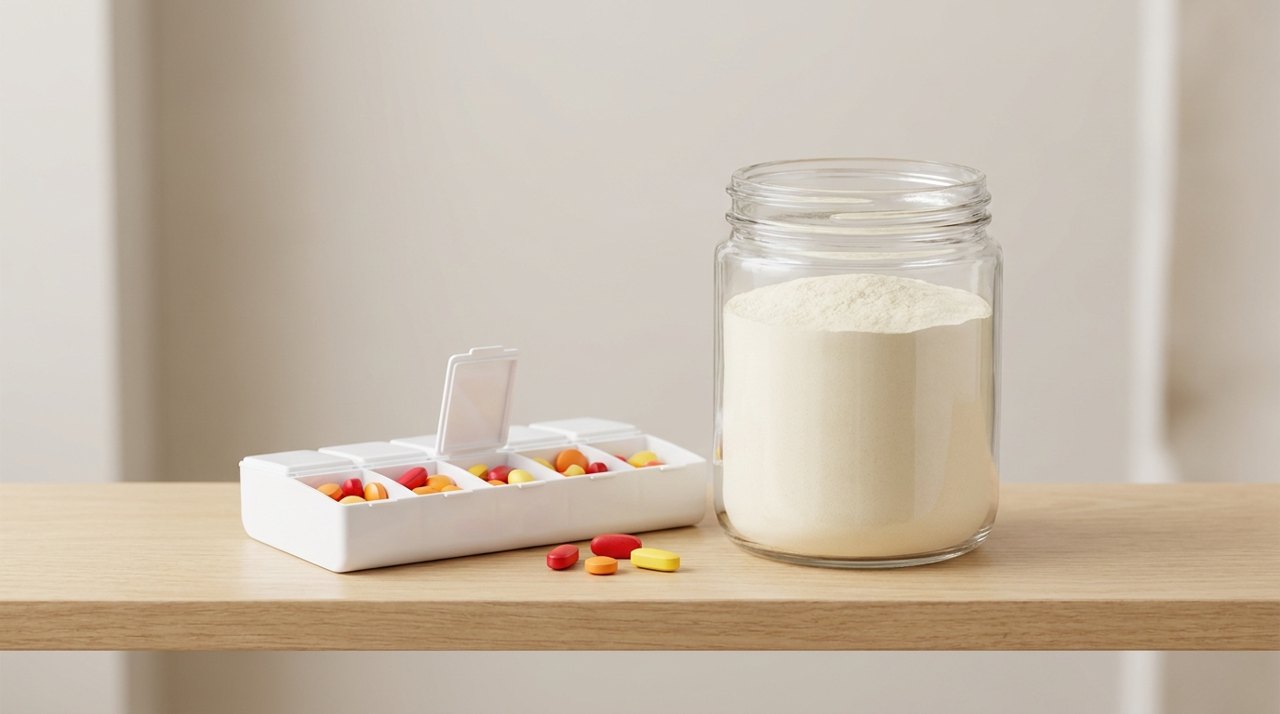
If your kitchen counter could talk, it would probably ask you to make some decisions. Between the multivitamin you've taken since college, the greens powder, the fish oil, and whatever arrived last month, shelf space — and habit space — is limited. So it's worth asking an honest question: if you're comparing colostrum and a multivitamin as a daily foundation, what does each one actually do, and does either deserve to be automatic? The answer, as usual, is more interesting than a simple winner-takes-all.
Two Fundamentally Different Ideas
A multivitamin and colostrum aren't really competitors — they're answers to two different questions.
A multivitamin answers: "Am I getting enough of the essential micronutrients my body can't make?" It's an insurance policy against gaps — vitamin D in winter, B12 for people who eat little meat, iron for some women. The nutrients are isolated, synthesized or extracted, and dosed to defined targets like the RDA.
Colostrum answers a different question: "Can I add back some of the bioactive compounds that a modern diet doesn't contain at all?" Bovine colostrum — the first milk produced in the hours after calving — is a whole food, not a nutrient formula. Its interesting components aren't vitamins; they're functional proteins and peptides: immunoglobulins (mainly IgG), lactoferrin, proline-rich polypeptides, oligosaccharides, and naturally occurring growth factors. No multivitamin contains any of these, because they aren't micronutrients — they're biological signals and defenses. (If you're curious what those growth factors actually do in adults, we've written a plain-English explainer on IGF-1 and TGF-β.)
What the Evidence Says for Each
Multivitamins: strong logic, surprisingly modest data
Here's something that surprises people: for generally healthy adults eating a reasonable diet, large trials of multivitamins have mostly failed to show meaningful benefits for long-term health outcomes. Reviews by bodies like the U.S. Preventive Services Task Force have repeatedly concluded the evidence is insufficient to recommend them for the general population. That doesn't make multivitamins useless — they clearly help correct genuine deficiencies, and specific groups (pregnancy, restricted diets, older adults, certain medications) may have real needs. But "covering your bases" turns out to be less transformative than the marketing suggests when your bases are mostly covered by food.
Colostrum: a smaller but more targeted body of research
Colostrum research is younger and the studies are smaller, so honesty matters here. That said, the research points in some consistent directions:
- Gut barrier support. Several studies suggest bovine colostrum may help maintain the integrity of the intestinal lining, particularly under stress — heavy exercise and NSAID use are the two best-studied scenarios.
- Upper respiratory resilience in athletes. A number of trials in hard-training athletes suggest colostrum may reduce the incidence of self-reported upper respiratory symptoms during intense training blocks, possibly by moderating the temporary immune dip that follows heavy exertion.
- Exercise recovery. Some studies suggest modest benefits for recovery and repeated performance, though results are mixed and effect sizes vary. Our article on colostrum for gym recovery and gut comfort digs into what's realistic to expect.
None of this rises to the level of "treats" or "prevents" anything — colostrum is a dietary supplement, and we'd be doing you a disservice to pretend otherwise. But the mechanisms are plausible, the compounds are genuinely unique, and the safety profile of a food humans have consumed for millennia is reassuring.
A Side-by-Side Look
| Multivitamin | Colostrum | |
|---|---|---|
| What it is | Isolated micronutrients, usually synthetic | A whole food with bioactive proteins |
| Core purpose | Fill nutrient gaps | Add compounds absent from the adult diet |
| Key components | Vitamins A–K, minerals | IgG, lactoferrin, growth factors, oligosaccharides |
| Best evidence for | Correcting true deficiencies | Gut barrier and immune support under stress (may help; research ongoing) |
| Weak spot | Modest benefit if your diet is already good | Smaller, shorter studies; quality varies widely by brand |
| Quality risk | Form and dose of nutrients | Harvest timing, heat processing, fillers |
Why Quality Changes the Math More for Colostrum
With a multivitamin, a mediocre product still delivers most of its label. With colostrum, quality is nearly everything, because the valuable components are fragile proteins. Colostrum collected late (after the immunoglobulin-rich first milking has given way to transitional milk), processed with high heat, or cut with milk powder and flow agents can look identical on the tub while delivering a fraction of the bioactivity. That's why the details matter: Bluegrass Colostrum is collected within six hours of calving — the true first milking, when immunoglobulin concentration peaks — from grass-fed American herds, then gently processed and third-party tested, with nothing else in the tub. It also matters how you take it: mixing it into very hot liquid can denature those proteins, which we cover in our piece on colostrum and coffee.
So Which One Earns the Shelf Space?
Ask yourself which question you're actually trying to answer:
- If your diet is genuinely gappy — you skip whole food groups, eat very restrictively, or a blood test has flagged a deficiency — a multivitamin (or better, a targeted single nutrient) is the rational pick. Colostrum won't fix low vitamin D.
- If your diet is decent but you're after gut comfort, training resilience, or immune support, colostrum is doing a job no multivitamin even attempts. Its compounds simply don't exist in a vitamin formula.
- If you can keep both habits, they don't overlap and don't conflict. Many of our customers take a multivitamin with breakfast and colostrum on an empty stomach first thing — the two occupy different roles entirely.
The honest framing isn't "colostrum versus multivitamin" but "gap-filler versus function-adder." A multivitamin makes sure nothing essential is missing; colostrum adds something your diet couldn't provide in the first place. If you do decide to give colostrum a fair trial, give it consistency — daily use for at least four to eight weeks — and a sensible dose, which we break down in our guide to colostrum dosing from 1 to 20 grams. Shelf space is earned by results you can feel, and both deserve the chance to prove it in your routine, not just in theory.
These statements have not been evaluated by the Food and Drug Administration. This product is not intended to diagnose, treat, cure, or prevent any disease.