How to Read a Colostrum Label Like a Pro: IgG %, Fillers and Red Flags
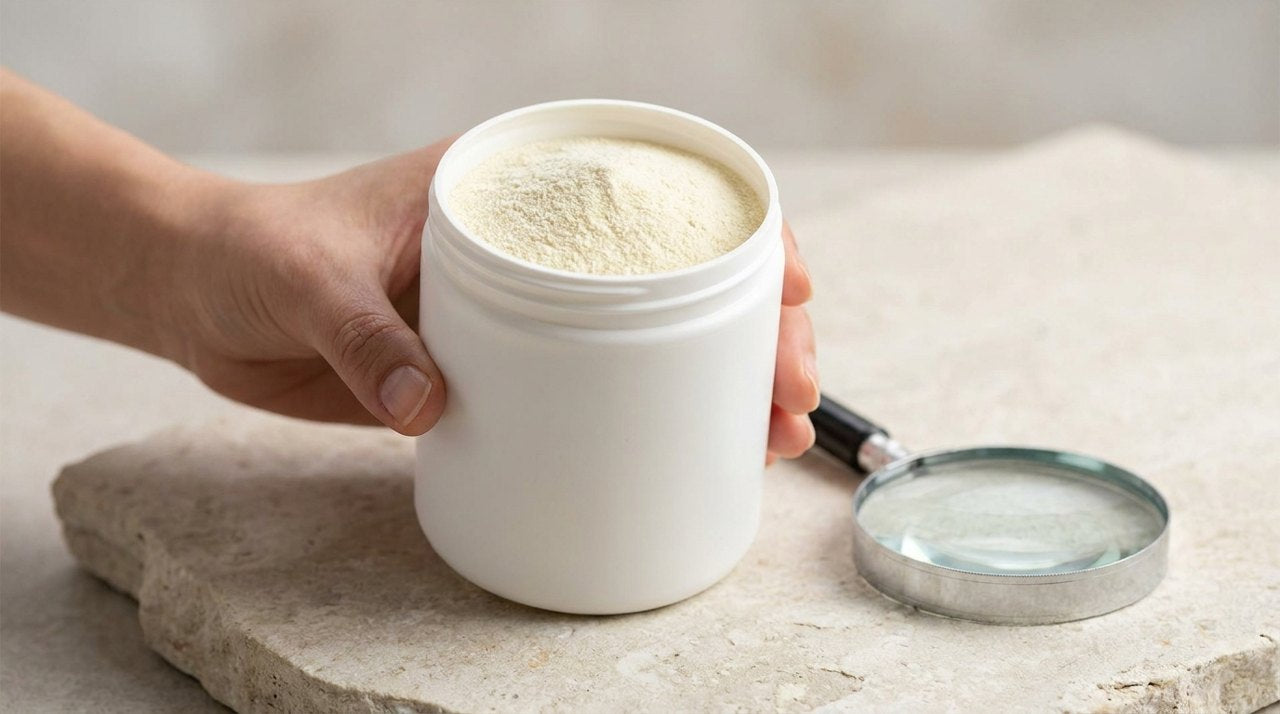
Colostrum labels have a way of looking reassuringly scientific while telling you surprisingly little. A big IgG number here, a "standardized" claim there, a serving size buried in small print. The good news is that reading one well takes about ten minutes to learn. Here is how to work through a colostrum label the way a careful buyer would, what each claim actually means, and the handful of details that separate a thoughtfully made product from a cleverly marketed one.
Start with the source, not the numbers
Before you look at any percentage, look at where the colostrum came from and when it was collected. Colostrum is the first milk a cow produces after calving, and its composition changes quickly. Research suggests that immunoglobulin concentration is highest in the first milking and declines steadily over the following days as the secretion transitions toward regular milk. A label that specifies collection within a narrow window, such as the first 6 to 12 hours, is telling you something meaningful about the raw material. A label that only says "bovine colostrum" with no timing detail may be using pooled milkings from several days.
Three things to look for on the source side:
- Collection window. "First milking" or a specific hour count is a stronger signal than "early lactation."
- Herd management. Grass-fed, pasture-raised, and hormone-free claims are worth noting, but check whether they are verified by anyone or simply stated.
- Country of origin. This tells you which dairy and food-safety regulations applied on the farm and in the processing facility.
One honest caveat: a cow's first colostrum is essential for her calf, and responsible producers only collect the surplus after the newborn has been fed. Brands that mention this practice are usually the ones that have thought carefully about the rest of their supply chain too.
What the IgG percentage does and does not tell you
Immunoglobulin G, or IgG, is the most-discussed component of colostrum and the number most brands lead with. It is a reasonable proxy for how concentrated and how early a colostrum is, but it needs context.
Percentage of what?
An IgG percentage is usually expressed as a share of total powder weight. So "20% IgG" in a 1-gram serving means roughly 200 mg of IgG per serving. Always do this arithmetic yourself, because a high percentage paired with a tiny serving can deliver less IgG than a moderate percentage in a generous serving. The table below shows how quickly the picture changes.
| Labeled IgG | Serving size | Approximate IgG per serving |
|---|---|---|
| 40% | 500 mg | 200 mg |
| 25% | 1,000 mg | 250 mg |
| 20% | 2,000 mg | 400 mg |
Is the number a minimum or a marketing figure?
Look for the words "minimum" or "not less than" near the IgG figure. Natural colostrum varies between batches, and a brand stating a guaranteed minimum is committing to a floor. A brand quoting a single round number without qualification may be reporting a best case.
Very high numbers deserve a second look
Whole colostrum powder naturally lands somewhere in the range of roughly 15 to 30 percent IgG depending on collection timing and processing. Figures well above that usually indicate the product has been fractionated or concentrated, which can be a legitimate choice but means you are no longer buying whole colostrum with its full spectrum of components. Neither approach is inherently better. You just want the label to be clear about which one you are getting.
Reading the ingredient list for fillers
The ingredient panel is where many premium-looking products quietly lose their premium status. Ideally a colostrum powder lists exactly one ingredient: bovine colostrum. Every additional line should have a reason.
- Flow agents and anti-caking additives. Silicon dioxide and similar agents are common in capsules and flavored blends. They are generally considered safe but add nothing nutritionally and take up weight that could be colostrum.
- Maltodextrin, dextrose and other carriers. These are sometimes used to dilute concentrated fractions back to a target percentage or to improve mixability. Their presence high on the list is a red flag for value.
- Sweeteners and flavors. Not a problem for people who prefer them, but be aware that a "vanilla colostrum" may be 20 to 30 percent non-colostrum by weight.
- Proprietary blends. If colostrum is folded into a blend with probiotics, herbs or protein, the label may not disclose how much colostrum you are actually getting per serving.
This is also why we keep Bluegrass Colostrum to a single-ingredient, unflavored format. It makes the label boring to read, which is exactly the point. If you are weighing formats, our comparison of capsules versus powder goes deeper into how fillers and serving sizes affect real cost per gram.
Processing terms decoded
Colostrum is sensitive to heat, and how it was dried matters. You will see a few recurring terms:
- Low-heat or low-temperature processed. Suggests the producer took steps to preserve heat-sensitive proteins. Useful, but vague unless a temperature range is given.
- Spray-dried. The industry standard. Done carefully at controlled temperatures it preserves most bioactive components; done aggressively it may not.
- Freeze-dried. Gentler on proteins in principle and typically more expensive. The evidence that it produces meaningfully better outcomes for the end user is limited, so treat it as a plus rather than a requirement.
- Pasteurized. Required for safety in most markets. Flash pasteurization at lower temperatures is preferable to prolonged high heat.
- Defatted or skimmed. Removes some fat to improve shelf life and IgG concentration by weight. Reasonable, but it does change the product from whole colostrum.
Testing claims: who checked, and for what?
"Third-party tested" has become one of the most common phrases on supplement labels and one of the least defined. Push past the phrase and ask four questions:
- Is the testing lab independent of the manufacturer, and is it named or accredited?
- Does testing cover IgG content, or only microbial safety and heavy metals? Both matter, and they are different tests.
- Is every lot tested, or was a single batch tested once for marketing purposes?
- Can you actually see a certificate of analysis, either on the website or by request?
A brand that publishes lot-specific results is making itself accountable in a way that a badge on the front of the tub does not. This becomes especially relevant if you plan to take colostrum for an extended period, a topic we cover in our article on long-term use.
A quick red-flag checklist
None of these alone proves a product is poor. Two or three together should make you pause.
- No collection window stated anywhere on the label or website.
- IgG quoted as a bare percentage with no serving-size math possible.
- Carriers or sweeteners listed before or immediately after colostrum.
- Disease-related promises. A reputable colostrum brand will describe it as a dietary supplement and will not claim it treats, cures or prevents anything.
- "Clinically proven" without a citation to a study on that specific product.
- Serving counts that look generous until you notice the serving is a fraction of a gram.
Putting it together
A good colostrum label reads almost like a farm record: when it was collected, how the herd was raised, how it was dried, what was measured and by whom. It states a guaranteed minimum IgG, lists one ingredient, and makes serving-size arithmetic easy. It also stays modest about what colostrum can do, because the human research, while encouraging in areas like gut and immune support, is still developing and often based on small studies. When a label is honest about that uncertainty, it is usually a sign the company has been honest about everything else too.
These statements have not been evaluated by the Food and Drug Administration. This product is not intended to diagnose, treat, cure, or prevent any disease.