Traveling Soon? Why Colostrum Belongs in Your Carry-On
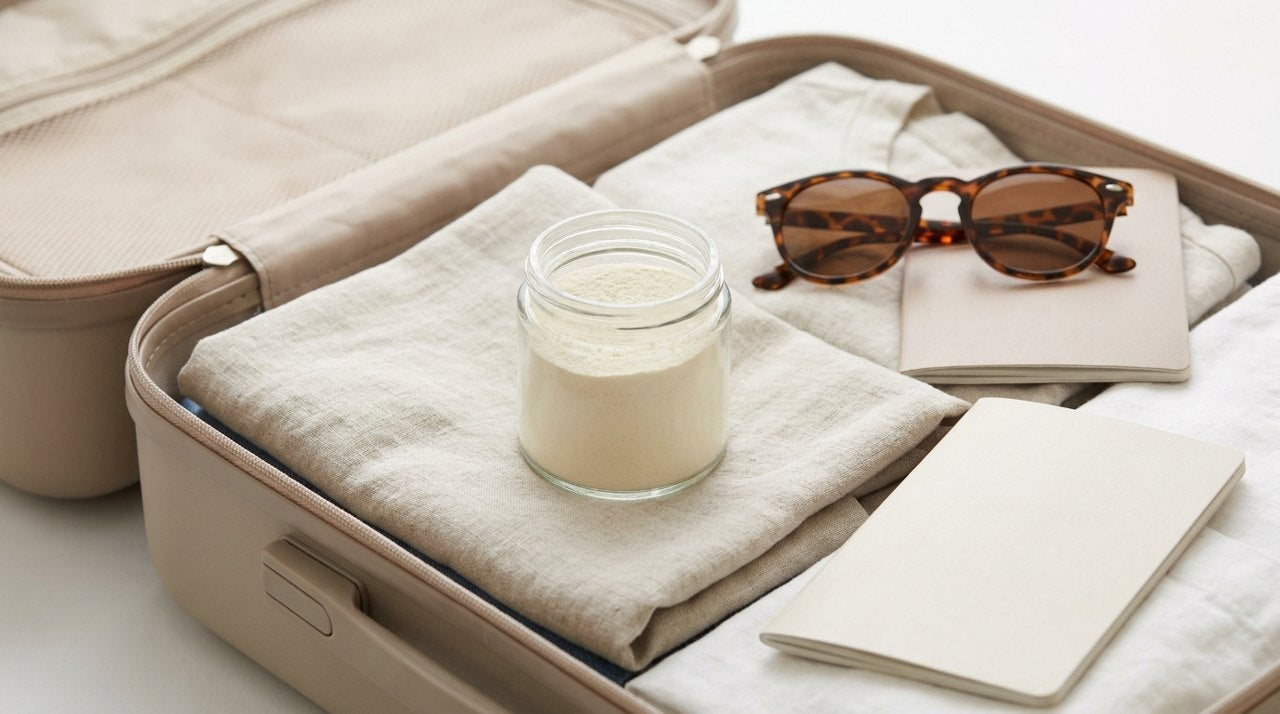
There's a particular kind of tired that only travel produces. You board the plane feeling fine, and three time zones later your stomach is confused, your sleep is wrecked, and everyone around you seems to be coughing. Travel is wonderful — and it's also one of the most reliable ways to throw your body's routines off balance. That's exactly why colostrum, a supplement best known for gut and immune support, has quietly become a favorite among frequent flyers. Here's the honest case for packing it, what the research does (and doesn't) say, and how to actually bring a powder through airport security without drama.
Why Travel Is Hard on Your Gut and Immune System
Travel stress isn't just in your head. Several physical factors stack up at once:
- Disrupted circadian rhythm. Your gut runs on a clock, too. Crossing time zones can shift digestion, appetite, and even the behavior of your gut microbiome, which may explain why travel constipation and irregularity are so common.
- New microbes everywhere. Airports, planes, hotel rooms, street food — you're meeting bacteria and viruses your body hasn't seen recently, often while sleep-deprived, which is precisely when your immune defenses tend to be less sharp.
- Cabin conditions. Airplane air is extremely dry, which can dry out the mucous membranes in your nose and throat — one of your body's first physical barriers against airborne germs.
- Diet chaos. Restaurant meals, unfamiliar water, more alcohol, less fiber. Your gut lining and its resident bacteria notice all of it.
None of this means you're doomed to spend day two of your vacation in bed. It just means travel is a moment when supporting your baseline — sleep, hydration, and yes, your gut — pays off more than usual.
Where Colostrum May Fit In
Bovine colostrum is the first milk a cow produces after calving. It's naturally concentrated in immunoglobulins (antibodies like IgG), lactoferrin, and growth factors — compounds designed by nature to protect and nourish a newborn's digestive tract. When adults take it as a supplement, two areas of research are most relevant to travelers.
Gut lining support
Some studies suggest bovine colostrum may help support the integrity of the intestinal lining, particularly under stress. Much of this research has been done in athletes, where heavy exercise temporarily increases intestinal permeability — a state with some parallels to the physical stress of long-haul travel. The evidence here is promising but not definitive; studies are often small, and results vary.
Immune support
Colostrum's immunoglobulins are the same class of proteins your own body uses to recognize pathogens. A handful of trials — again, mostly in athletes — suggest colostrum supplementation may be associated with fewer self-reported upper respiratory symptoms during periods of intense training. Whether that translates directly to a week of airports and conferences hasn't been rigorously tested, so consider this a reasonable "may help," not a guarantee. Colostrum is a dietary supplement, not a shield: it doesn't treat or prevent illness, and it's no substitute for washing your hands and getting sleep.
If you're weighing colostrum against travel probiotics, they're not really competitors — colostrum works on the gut environment and lining, while probiotics add live organisms. We compared them in detail in Colostrum vs. Probiotics: Rivals or Teammates for Gut Health?
Why Powder Beats Capsules for Travel (Mostly)
A quality colostrum powder like Bluegrass Colostrum has a few practical advantages on the road. Because it's unflavored and additive-free, it stirs into whatever's available — bottled water, a hotel-room glass of milk, a morning smoothie — without needing to choke down a stack of capsules. It's also shelf-stable, so it doesn't care about hotel minibar temperatures. The one caveat: powder requires a little more thought at security, which brings us to logistics.
Getting Colostrum Through Airport Security
Good news: powders are allowed in carry-on bags. In the U.S., TSA permits powder-like substances in carry-ons, though containers over 12 ounces (about 350 mL) may need to be placed in a separate bin for additional screening. A typical colostrum jar is well under that threshold — a 120-gram jar isn't remotely close to the limit. Still, a few habits make screening smoother:
- Keep it in the original labeled container. A jar with an ingredient label and brand name raises far fewer questions than a zip-top bag of unmarked white powder. This is worth the extra ounces.
- Pack it in your carry-on, not checked luggage. Checked bags get delayed and lost; your supplement routine shouldn't depend on baggage handlers. Carry-on also avoids extreme cargo-hold temperature swings.
- Check destination rules for international trips. Most countries allow personal-use quantities of dietary supplements, but a few (Australia and New Zealand, notably) are strict about declaring animal-derived products. Declare it on arrival forms if asked — a sealed, commercially labeled dairy-derived supplement is usually fine, but honesty at customs is always the right call.
- Bring a small scoop or pre-count your servings. If you're traveling for a week, you don't need the whole jar's 60 servings — but the original jar is still the safest way to carry it.
A Simple Travel Routine
Consistency matters more than perfect timing, but here's an easy rhythm for a trip:
| When | What to do |
|---|---|
| 2–3 days before departure | Start (or continue) your daily serving so you're not introducing anything new mid-trip. |
| Travel day | Take your serving with water before heading to the airport, then hydrate aggressively in flight — dry cabin air is working against you. |
| Each morning of the trip | One serving in water, ideally before breakfast. Many people prefer taking it on an empty stomach; we dug into whether that actually matters in Should You Take Colostrum on an Empty Stomach? |
| After you're home | Keep going for a few days while your sleep and digestion resettle. |
A Few Honest Caveats
Colostrum is a dairy product. If you have a true milk allergy, skip it. If you're lactose intolerant, many people tolerate colostrum's small lactose content well, but start with a partial serving and see how you feel. And if you're pregnant, nursing, or managing a health condition, run any new supplement — this one included — past your healthcare provider before your trip, not at the departure gate.
Finally, quality varies widely in this category, and a jar that travels with you should be one you trust. Look for grass-fed sourcing, early-harvest collection, no fillers, and third-party testing — the things that separate true first-milking colostrum from diluted "transition milk" powders. If you're curious what that standard looks like in practice, our piece From Farm to Jar: How BIOMIXA Colostrum Is Made walks through it step by step.
Travel will always be a little chaotic. Your supplement routine doesn't have to be.
These statements have not been evaluated by the Food and Drug Administration. This product is not intended to diagnose, treat, cure, or prevent any disease.