Does Colostrum Break a Fast? Calories, Insulin and Smart Timing
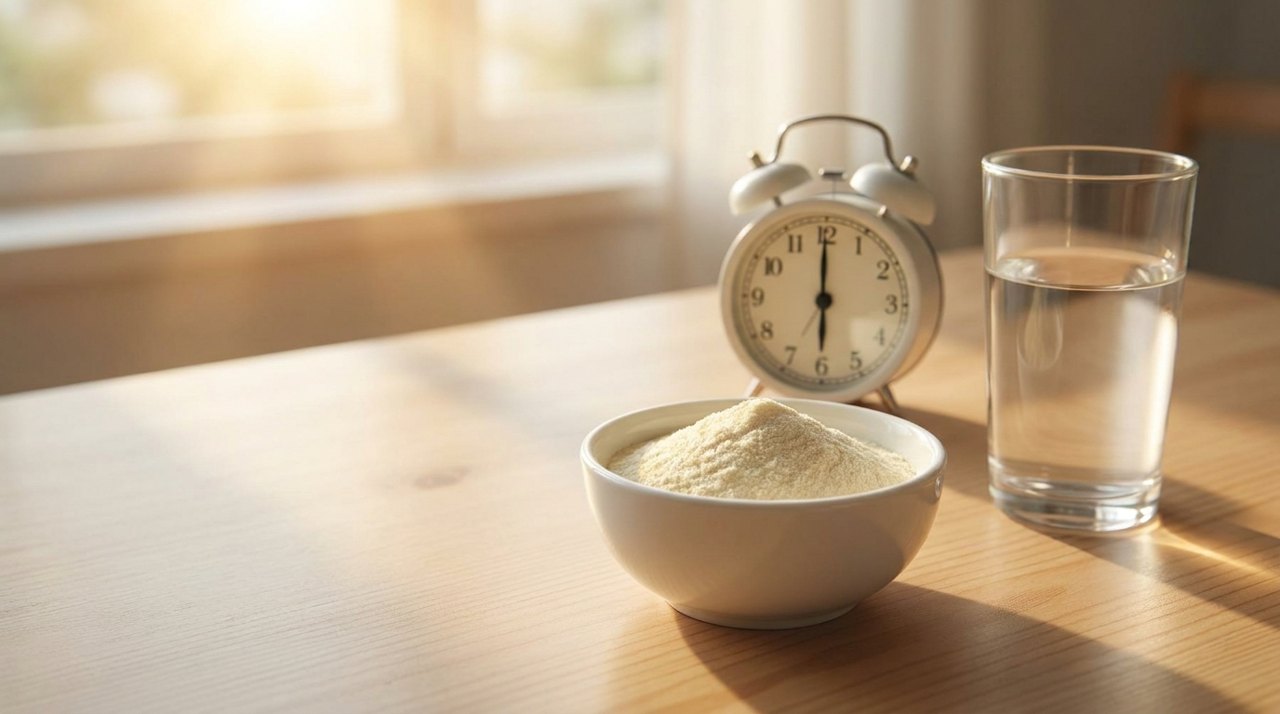
If you practice intermittent fasting, you've probably wondered whether a scoop of colostrum during your fasting window undoes your effort. The honest answer: technically, yes, colostrum breaks a strict fast, because it contains calories and protein. Whether that matters depends on why you're fasting. Below we look at what's actually in a serving, how it may affect insulin, and how to time it around your fasting window without second-guessing yourself.
What's actually in a serving of colostrum
Bovine colostrum is the first milk a cow produces after giving birth. Compared with regular milk it is concentrated in immunoglobulins (especially IgG), along with lactoferrin, growth factors and other bioactive proteins. It also contains ordinary nutrients: protein, a little fat and some lactose.
Colostrum servings are small. A pure powder serving is usually a couple of grams, so the calorie count is low, often under 10 calories. The exact figure depends on the product and the scoop size, so check the nutrition panel on your jar. If you aren't sure what the numbers mean, our guide on how to read a colostrum label explains serving size, IgG percentage and fillers.
For fasting, the important point isn't the small calorie count. It's that most of those calories come from protein, and protein is the nutrient some fasting goals are most sensitive to.
Does colostrum spike insulin?
We don't know of any research that has measured insulin after a typical supplement-sized dose of colostrum taken while fasting. So we have to reason from what's known about its ingredients, and that reasoning should be read as an estimate, not a conclusion.
- Protein and amino acids can trigger a modest insulin response even without carbohydrate. Dairy proteins are known to be fairly insulinogenic when eaten in normal meal-sized amounts.
- Lactose is a sugar, but a serving of a couple of grams contains very little of it.
- Growth factors such as IGF-1 are present in colostrum. How much survives digestion, and whether it has any meaningful effect on your body at supplement doses, is still debated in the research.
Taken together, a small serving of colostrum probably causes, at most, a small and short-lived metabolic response. That is an estimate based on its composition, not something that has been measured. If precise blood-sugar or insulin control matters to you for medical reasons, talk to your clinician. Don't rely on general rules of thumb.
It depends on why you're fasting
"Breaking a fast" means different things to different people. Here is how colostrum fits the most common goals:
| Fasting goal | Does a small serving of colostrum interfere? |
|---|---|
| Calorie control or weight management | Very unlikely to matter. A few calories are negligible over a whole day. |
| Keeping insulin low or staying in ketosis | Possibly a small effect from the protein. Many people find a small serving doesn't noticeably change their ketone readings, but individual responses vary. |
| Autophagy or a "clean" fast | Probably yes. Amino acids are thought to signal "fed" pathways such as mTOR, so purists should save colostrum for the eating window. |
| Giving your digestion a rest | It technically counts as intake, though a light one. |
| Religious or medically supervised fasts | Follow the rules of your tradition or your care team. Colostrum is food. |
A note on autophagy: most of what we know about autophagy and protein comes from cell and animal studies. We don't have a reliable way to say how much a gram or two of protein changes autophagy in a person who has been fasting. If you want to be strict, the simplest rule is no protein until the window opens.
Smart timing strategies
Option 1: Take it when your eating window opens
This is the simplest option and it works for every fasting style. Take colostrum with water, or stir it into your first meal or drink. Your fast stays fully intact and you don't have to think about it.
Option 2: Take it before your first meal
Some people take colostrum 15 to 30 minutes before eating, reasoning that its immunoglobulins may be digested less on a relatively empty stomach. This idea is plausible but has only limited research behind it. It's a reasonable personal preference, not a proven advantage. Because you're about to eat anyway, it costs nothing either way.
Option 3: Take it during the fast (if your goals allow)
If you fast mainly for calorie control or convenience, a serving partway through the fast is unlikely to undo anything meaningful. Mix it into water or black coffee, not into milk or creamer, so the colostrum is the only thing you're adding.
Option 4: Take it with your last meal
If mornings are hectic, there's nothing wrong with taking colostrum before you close your eating window in the evening. The best schedule is one you'll actually stick to.
A few practical tips
- Keep the formula simple. Flavored blends can add sweeteners, carbohydrates or creamers that matter more for fasting than the colostrum itself. An unflavored, single-ingredient powder like Bluegrass Colostrum lets you know exactly what you're consuming.
- Mix with cool or warm liquid, not hot. Very hot water may affect some of colostrum's delicate proteins, and powders tend to clump in it.
- Be consistent. Most colostrum studies used daily intake over weeks, not occasional doses. A fixed time of day helps more than the perfect time of day.
- Watch how you feel. If you are sensitive to dairy, colostrum on an empty stomach may not suit you. Try it with food instead.
- Test it if you track metrics. If you use a ketone meter or a continuous glucose monitor, check your own response for a week. Your own data will tell you more than any general rule.
What about capsules?
Capsules contain the same colostrum, so the fasting question is the same. They are usually a lower dose per capsule, and some contain fillers or flow agents. If you're choosing between formats, our comparison of colostrum capsules vs. powder covers dose, cost and convenience.
The bottom line
Strictly speaking, colostrum breaks a fast. It contains calories and protein, and protein is what strict fasters, especially those focused on autophagy, usually try to avoid. In practice, a small serving is unlikely to matter much if you fast mainly for calorie control or for the structure of time-restricted eating. If you want certainty, take colostrum when your eating window opens. If you're more flexible, choose whatever time you'll stick to every day. If you have diabetes, are pregnant or breastfeeding, or are fasting under medical supervision, check with your healthcare provider before changing your routine.
These statements have not been evaluated by the Food and Drug Administration. This product is not intended to diagnose, treat, cure, or prevent any disease.